There's an excellent if brief piece in last week's
Maclean's that outlines the
surreptitious but very real presence of Chinese spies in Canada. This comes on the heels of Chinese-born Canadian Celil Huseyin's life sentence, handed to him by Chinese courts on the premise that Celil is a Uighur nationalist (according to mainland law, not only are Uighur nationalists a very bad thing, but dual citizenships such as Celil's don't count for much, either).
And thus off to prison he goes. In his tracks: a stupefied Canadian government that, as far as I can tell, either has
no idea what it is doing, or has several contradictory ideas and doesn't understand the concept of "management". As J. Michael Cole at the
Taipei Times writes,
Sadly for Celil and [Maher Arar] precedent notwithstanding, he is unlikely to receive much help from Ottawa -- or the rest of the international community, for that matter. And the reason is simple: China.
It is one thing for Canada to reprimand Syria on human rights for the very real possibility that individuals in its prison system are being badly treated, if not tortured. [...]
But hapless Celil has a tremendous handicap: China's economy and the lure it has, siren-song-like, on other countries. Statistics from Foreign Affairs and International Trade Canada show that Canada's total trade with China last year was close to C$42 billion (US$37.3 billion), while two-way trade with Syria for the same period was approximately C$72 million. China's GDP was estimated at US$2.225 trillion in 2005. Syria's was US$25.84 billion. [...]
It is one thing to "anger" Damascus and put bilateral trade at risk; it is quite another when it comes to China.
It seems to me that the Canada-China connection is slowly turning into one of the world's great publicly mismanaged relationships, a heap of economic and political potential that seems to lack any clear vision. Even today, breaking his usual post-Harper silence, former Prime Minister Paul Martin
weighed in on the debate.
It's no secret that Canada has for eons attempted to diversify its export portfolio beyond the great consumer market to the south — take Trudeau and his failed Third Option trade initiative with the European community, for example.
Post-9/11, the reality that the Canada-U.S. border could be closed in a heartbeat has become all too real, especially if a porous border becomes a threat to American national security.
China presents Canada with a real opportunity for economic change. We have resources;
China wants them. At the same time, the Chinese government and ruling communist party are very unpopular in Quebec, a key battleground in Canada's electoral landscape. Governments throughout the world have been reticent to threaten China with real consequences when faced with the CCP's human rights regime. Empty words and criticism? Sure. Real action? Absolutely not. The taste of China's economic teet is simply too sweet to dismiss, especially when the alternative is considered: human rights — hardly profitable.
Canada wants to play the China game somewhere in the middle.
Criticize,
embrace;
become strategic partners,
keep a distance. Play a human rights card; play a Canada card. Feign indignation. Our "strategy" has clearly
miffed the Chinese. As with many things in Canadian foreign policy of late, "unrealized potential" is, sadly, the shoe that fits.
If our government wishes to affect change in China on matters of Canadian interest — Celil is a prime example — it needs to take a clearer position: foster a relationship,
as it seems to want to, or get out. The CCP has no real stake here, and we have no real stake there. Until that changes, Chinese leaders can quite simply ignore Canada, regardless of what card we play.
〜
Labels: canadian foreign policy, china, human rights
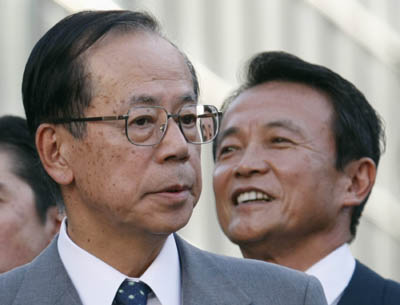 Just two weeks after the meteoric, Paul Martin-esque rise and fall of Prime Minister Shinzo Abe, Japan is set to have a new chief executive: 71-year-old Yasuo Fukuda.


